
For the last decade, SaaS architecture was often described too simply: either you ran a multi-tenant SaaS platform, or you built custom private deployments for large customers.
That binary view is breaking down.
Enterprise buyers now want stronger isolation, safer AI execution, regional control, customer-specific environments, and more predictable blast-radius management.
This is where two models are becoming increasingly important: Single-tenant SaaS and cellular multi-tenant SaaS.
They are not the same as BYOC and Air-gapped deployment models. They are complementary and solve different needs. Having said that, like BYOC and Air-gapped, they are becoming essential deployment patterns for software companies selling into enterprise customers.
What Is Single-Tenant SaaS? (Dedicated Tenancy)
Single-tenant SaaS means each customer gets a dedicated runtime environment, while the vendor still owns and operates the service as SaaS.
The customer is not bringing their own cloud account. The vendor is still responsible for hosting, operations, upgrades, reliability, security patches, monitoring, backups, and support.
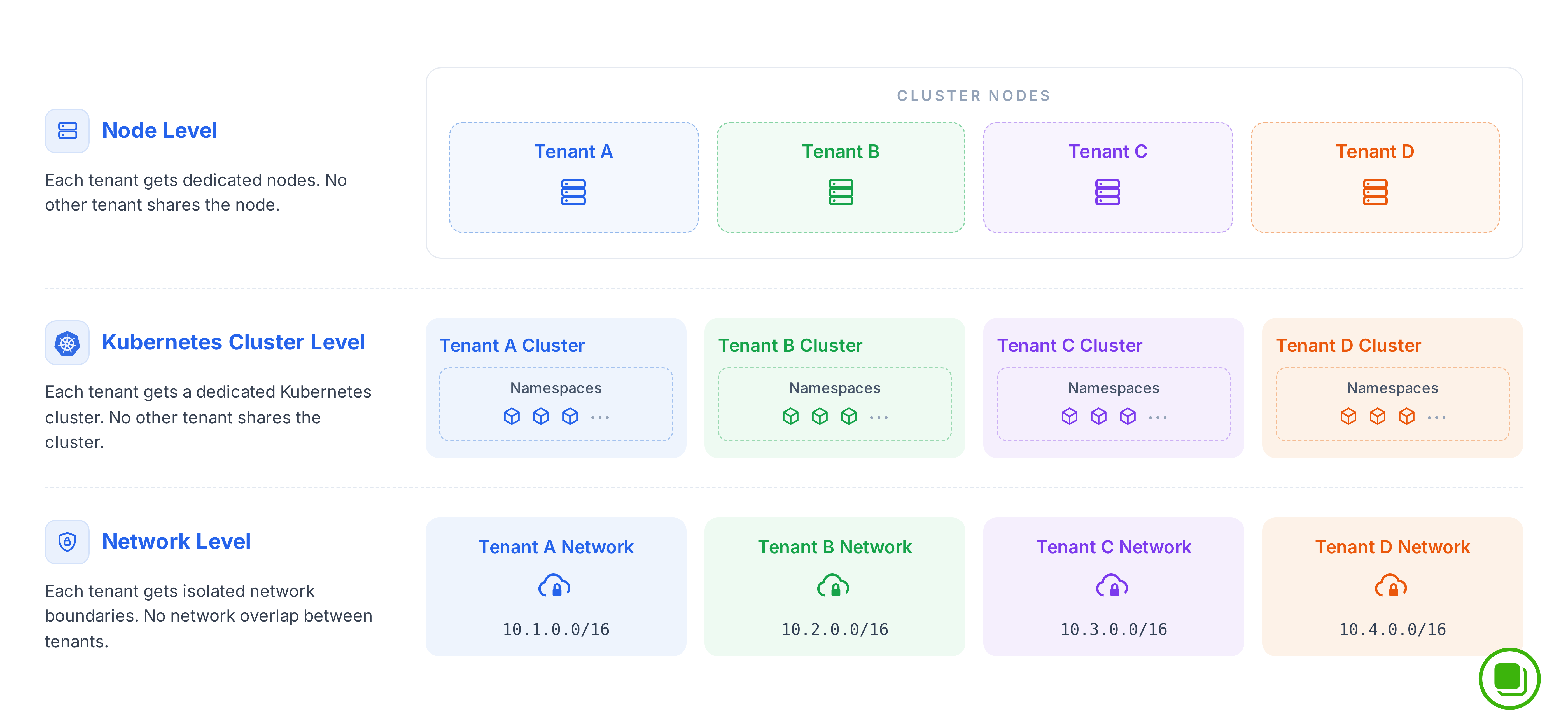
Figure 1: The figure shows tenant isolation across dedicated nodes, Kubernetes clusters, and separate network boundaries.
The isolation boundary can vary by product. A single-tenant SaaS deployment may provide dedicated:
- Application pods
- Kubernetes namespaces
- Nodes
- Kubernetes clusters
- Network boundaries
- Cloud accounts
Infrastructure stacks may involve other components like databases, storage volumes, encryption keys, SaaS endpoints, load balancers, etc. A dedicated stack will have to enforce isolation on these components as well.
It means the vendor provides a stronger tenant-specific isolation boundary than traditional pooled SaaS. That boundary can exist at many layers of the stack.
AWS’s SaaS Lens documentation describes the “silo” model as a pattern where tenants are provided dedicated resources, such as a fully independent infrastructure stack or a separate database. It also describes “pool” and “bridge” models where some resources are shared and others are isolated.
Single-tenant SaaS is best understood as: Vendor-hosted SaaS with a dedicated runtime boundary per customer.
What Is Cellular Multi-Tenant SaaS?
Cellular multi-tenant SaaS is a model where the SaaS platform is divided into many smaller, isolated operating units called cells.
Each cell serves a subset of tenants. The platform is still multi-tenant, but not all customers live in one giant shared production environment.
A cell may be organized by:
- Region
- Customer tier
- Workload type
- Compliance posture
- Cloud provider
- Capacity profile
- Data residency requirement
- Operational blast-radius boundary
The important distinction is that a cell is not just “another cluster.” It is an operating unit with its own routing, capacity, failure domain, upgrade wave, observability boundary, and tenant placement logic.
- Traditional multi-tenant SaaS says: Put everyone into one shared platform.
- Cellular multi-tenant SaaS says: Group tenants into bounded cells so the platform can scale, isolate failures, and support different operating profiles.
This is especially useful when a product needs the economics of multi-tenancy but cannot tolerate a single large shared failure domain. In a large pooled SaaS system, one bad deployment, noisy customer, data-plane issue, or regional failure can affect many tenants. Cellular architecture reduces this risk.
Instead of one huge shared system, the vendor operates many smaller cells. Each cell has its own operational boundary. Failures are contained. Upgrades can roll out cell-by-cell. Capacity problems can be isolated. Customer placement can be controlled. This is one of the biggest reasons cellular SaaS becomes attractive as platforms mature. It enables vendors to scale without tying every customer to the same operational fate.
How Single-Tenant and Cellular SaaS Differ From Traditional SaaS
Traditional SaaS usually optimizes for efficiency through application multi-tenancy. Customers share the same application layer, database layer, control plane, operational workflows, and infrastructure. This is especially simple to operate at a smaller scale and cost-efficient when customer requirements are similar.
But traditional pooled SaaS becomes harder when customers need any of the following:
- Stronger isolation
- Dedicated performance envelopes
- Customer-specific upgrades
- Regional separation
- Regulated environments
- AI workload sandboxing
- Separate dev, QA, and production environments
- Lower blast radius
- Premium enterprise controls
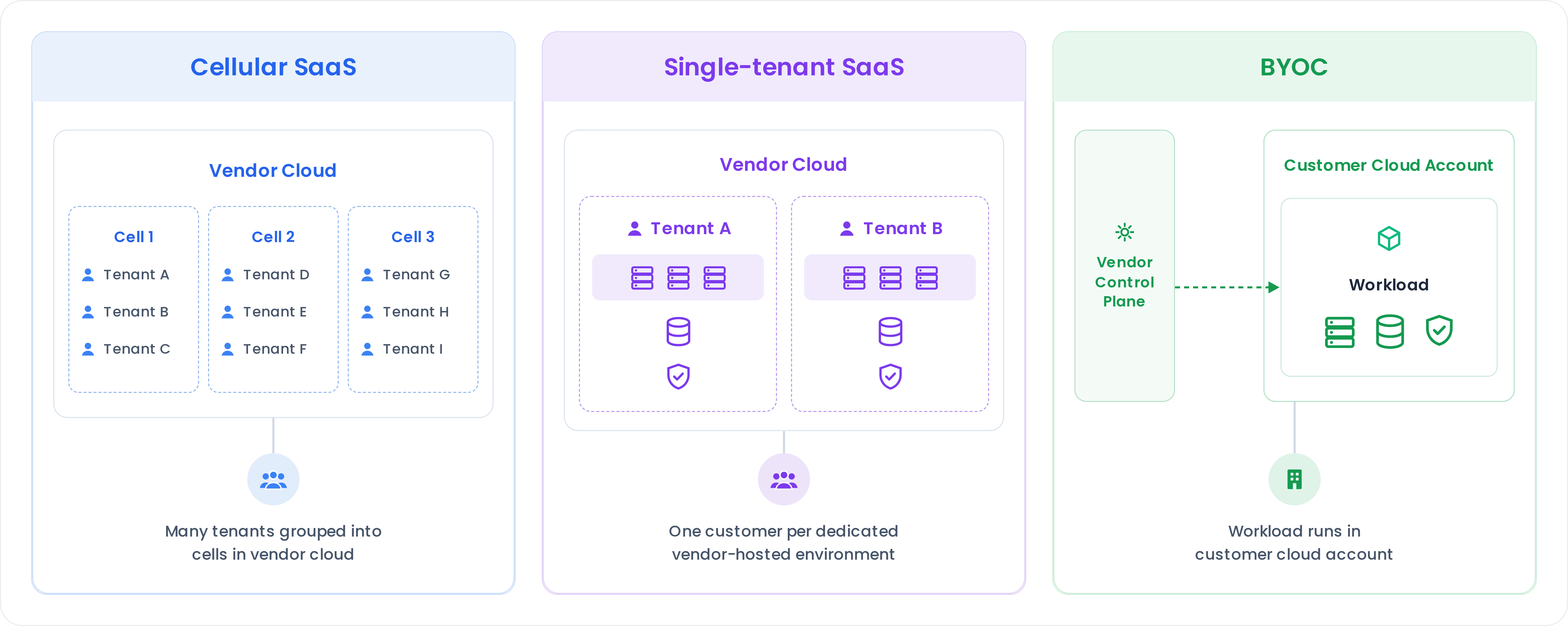
Figure 2: Isolation boundaries across Cellular SaaS, Single-Tenant SaaS, and BYOC.
In a comparison across different deployment models,
Traditional SaaS is best for low-cost, self-serve onboarding where shared infrastructure is acceptable.
Cellular Multi-Tenant SaaS is best for platforms scaling upmarket that need blast-radius containment and regional routing.
Single-Tenant SaaS is best for enterprise accounts demanding strict compliance, dedicated runtimes, and custom SLAs.
BYOC's four primary deployment variants are best for workloads requiring customer cloud control, strict data locality, and cloud commits.
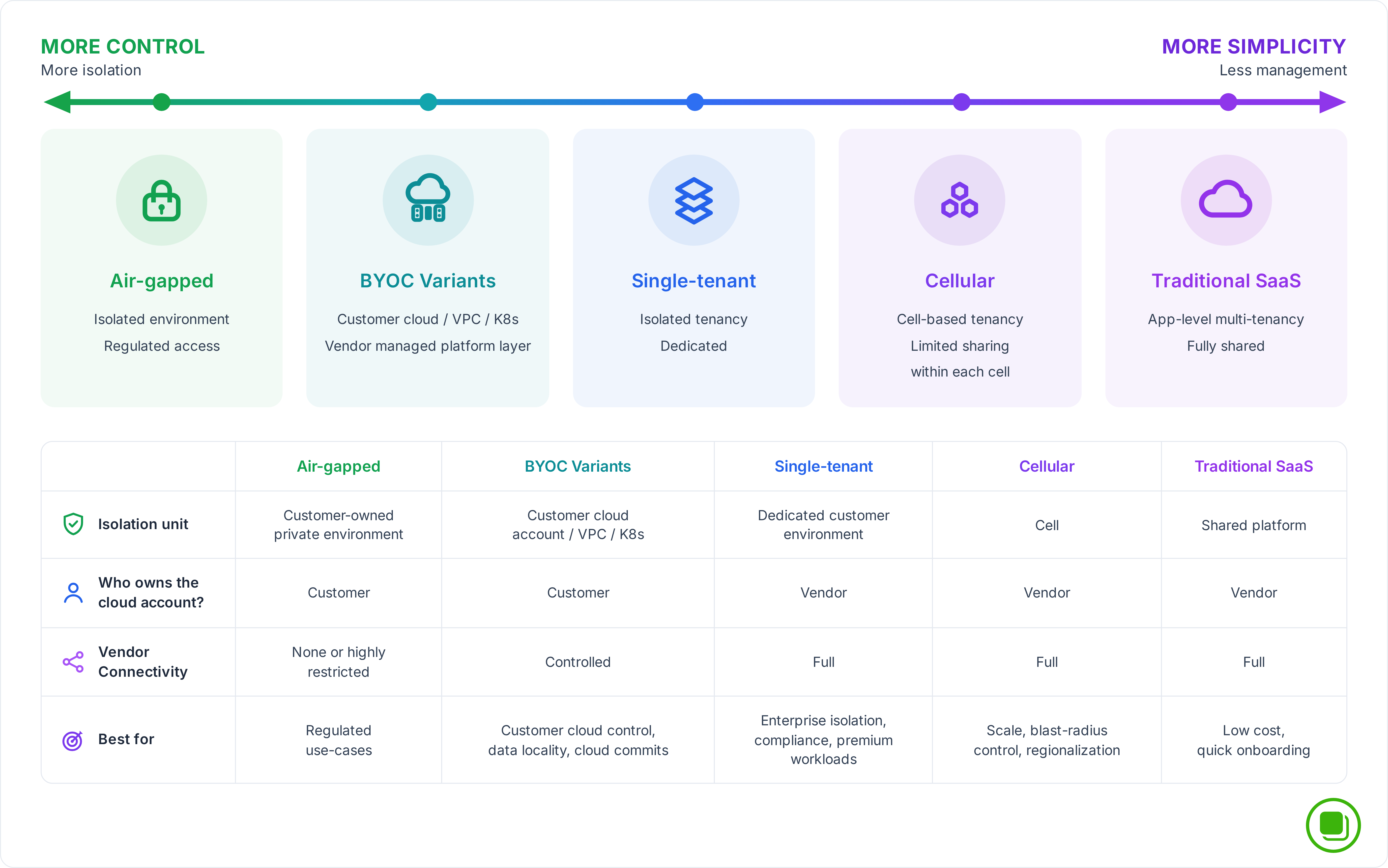
Figure 3: A comparison of deployment models from air-gapped to shared SaaS.
The key architectural shift is this:
- Traditional SaaS pools first pushing the complexity of scaling, blast radius, and customization needs due to regulatory or customer requirements concerns into the future.
- Single-tenant and cellular SaaS isolate first - then decide what can safely be shared.
Single-Tenant and Cellular SaaS Are Not BYOC
Single-tenant SaaS and cellular multi-tenant SaaS are often confused with BYOC because all three can improve isolation. But they are not the same model. While BYOC addresses workloads that must run in customer-owned cloud accounts, single-tenant and cellular SaaS tackle isolation inside vendor-managed environments.
Under BYOC, the customer owns the cloud account, network boundary, cloud bill, IAM surface, and often the compliance controls around the environment. In contrast, single-tenant SaaS means the workload runs in a vendor-controlled environment, but with a dedicated boundary for the customer. Cellular multi-tenant SaaS means the workload runs in a vendor-controlled environment, but tenants are grouped into bounded cells instead of one global pool.
In other words:
- BYOC is about customer-controlled infrastructure.
- Single-tenant SaaS is about customer-specific isolation.
- Cellular SaaS is about controlled multi-tenant scale.
That difference is not semantic. Because the ownership boundary is different, it changes almost everything:
- Who owns the cloud account and cloud bill.
- Who controls IAM, security groups, VPCs, private networking, and encryption policies.
- Where customer data, logs, backups, and operational metadata reside.
- How support access is granted, audited, and revoked.
- How upgrades, rollbacks, and incident response are executed.
- How tenant placement, capacity, and blast radius are managed.
- How compliance evidence is produced.
- How costs are allocated, marked up, or passed through.
- How onboarding is automated.
- How failures are isolated across customers, cells, regions, and environments.
They may share some aspects — but the control boundary is fundamentally different. BYOC gives customers the strongest cloud ownership. But it also creates more complexity. Single-tenant SaaS and cellular SaaS offer better isolation than traditional SaaS without forcing the customer to become part of the infrastructure operating model. This has several implications:
- Lower-friction onboarding without asking the customer to bring their cloud accounts.
- Cost-effective pricing, since BYOC often involves higher operating costs.
- Lower infrastructure cost as a vendor who is operating at some scale can typically procure better pricing from the cloud providers than their startup segment, and also pass on the benefits of shared infrastructure.
- The vendor wants to show infrastructure spend inside its own operating model.
- Vendor-controlled upgrade windows, incident response, observability, and reliability management.
- A cleaner procurement and support experience.
- Stronger isolation than pooled SaaS, but without making the customer responsible for cloud infrastructure ownership.
Calling them the same is a category error. Even from the technical perspective, they are completely different under the hood:
In single-tenant SaaS, the hard problem is creating repeatable customer-specific isolation inside the vendor’s own SaaS estate. That can mean dedicated pods, namespaces, nodes, databases, clusters, networks, accounts, keys, backup policies, upgrade windows, or observability boundaries. The vendor controls the infrastructure substrate and decides which layers are dedicated versus shared.
In cellular multi-tenant SaaS, the hard problem is cell design: tenant placement, routing, capacity per cell, cell-level observability, cell-by-cell deployments, rebalancing, failure isolation, and upgrade waves. A cell is an operating boundary, not just another cluster.
In BYOC, the hard problem is different: deploying and operating software across customer-owned cloud accounts and environments. Navigating the spectrum of BYOC deployments requires handling external IAM, customer VPCs, private connectivity, customer-specific cloud policies, limited vendor access, account bootstrap, customer-controlled security posture, heterogeneous environments, and support workflows where the vendor does not fully own the infrastructure boundary.
So while all three models require serious control-plane automation, they optimize for different things:
- Single-tenant SaaS optimizes for customer-specific isolation inside the vendor’s cloud.
- Cellular SaaS optimizes for controlled multi-tenant scale and blast-radius containment.
- BYOC optimizes for customer-controlled infrastructure and data locality.
Those are not interchangeable architectures.
Why ISV Customers Are Now Demanding Stronger SaaS Isolation
1. AI Agents Force a Need For Stronger Sandboxes
AI agents behave differently from traditional SaaS workflows.
A normal SaaS feature usually follows a predictable request path. An agent may retrieve context, call tools, inspect systems, write outputs, invoke APIs, generate code, or take multi-step actions.
That creates new enterprise concerns:
- What can the agent access?
- Can we isolate agent execution?
- Can we audit every action?
- Can we separate customers, teams, or environments?
- Can we limit blast radius if the agent behaves unexpectedly?
- Can production be isolated from dev and QA?
Single-tenant SaaS gives each customer a stronger sandbox. Cellular SaaS allows vendors to group risk profiles and control blast radius without giving every customer a fully dedicated environment. For AI-native products, these patterns are becoming architectural requirements, not enterprise nice-to-haves.
2. Regulatory Risk is Becoming an Operational Requirement
Regulatory requirements increasingly affect runtime architecture, not just legal paperwork.
For many of your customers, the requirement is as basic as: keep PII, customer records, logs, or regulated data within the local region.
A European customer may want EU personal data processed and stored locally to reduce cross-border transfer complexity; GDPR protections continue to apply when personal data leaves the EEA, and transfers outside the EEA require approved safeguards. (European Commission) A healthcare customer may need tighter controls around systems that handle protected health information, including vendor relationships that involve PHI. (HHS.gov) Similarly, an India-based enterprise may need to account for rules that allow the government to restrict transfer of personal data to certain countries. (India Code)
AI adds another layer. For high-risk AI systems, the EU AI Act introduces obligations around oversight, monitoring, input data relevance, and log retention. That turns architecture into part of the compliance story: where the system runs, where logs live, how tenants are isolated, and how behavior is monitored.
That allows you to ask practical architecture questions:
- Where is PII stored and processed?
- Can regional customer data remain strictly within local boundaries?
- Can regulated customers run in dedicated environments?
- Can dev, QA, and production be separated?
- Which tenant can access which data?
- Can we prove isolation?
- Can logs and audit trails stay within the required boundary?
- Can upgrades be rolled out safely by customer, environment, or region?
Single-tenant and cellular architectures answer these questions with a far cleaner operating model than one large shared SaaS platform. They let vendors map customers to the right runtime boundary — dedicated environment, regional cell, regulated cell, or production-only cell — without turning every regulated customer into a bespoke deployment.
3. ISV Customers Are Demanding Environment-Level Isolation
As SaaS products become more infrastructure-like, environment isolation matters more.
Customers often need separate environments for:
- Production
- Staging
- Dev
- QA
- Regulated testing
- Regional rollout
- Security validation
- Customer acceptance testing
In traditional SaaS, these environments are often simulated through configuration. In enterprise software, config-based separation leaves zero margin for human error, potentially turning a single unindexed query or bad database migration into a cross-environment outage.
Single-tenant SaaS allows a vendor to provide customer-specific environments with stronger separation.
Cellular SaaS allows a platform to run different lifecycle stages or tenant classes in separate cells, reducing cross-environment risk.
4. Different Customer Segments Need Different Tenant Isolation Boundaries
Not every customer should be served the same way. A small startup trial, a mid-market customer, a regulated financial institution, and a Fortune 500 AI deployment may all use the same product, but they should not necessarily run in the same environment.
Deploying across cellular SaaS, single-tenant SaaS, BYOC, and air-gapped architectures allows vendors to map customers into different operating tiers based on their isolation needs.
The future of enterprise SaaS is not one deployment model - it is a portfolio.
When to Consider Single-Tenant SaaS and Cellular SaaS
You should consider single-tenant SaaS if customers ask for:
- Dedicated runtime isolation
- Customer-specific environments
- Premium SLAs
- Separate production and non-production environments
- Stricter data boundaries
- Customer-specific upgrade windows
- Stronger compliance evidence
You should consider cellular multi-tenant SaaS if your platform has:
- Too many customers in one shared production environment
- Growing blast-radius concerns
- Noisy-neighbor problems
- Regional expansion needs
- Different customer tiers
- AI workloads with different risk profiles
- A need to roll out upgrades progressively by customer group
You should consider both if you are moving upmarket.
Enterprise customers rarely want only “standard SaaS.” They want SaaS convenience with stronger isolation, safer operations, and deployment patterns that match their risk posture.
Right-Sizing SaaS Tenant Isolation: Control, Compliance, and Scale
The best ISVs are not asking, “Are we SaaS or BYOC?”. They are asking: What level of isolation, control, and operational ownership does each customer segment need?
That is the strategic shift.
Traditional pooled SaaS is still useful. But it is no longer enough for every customer or every workload.
Single-tenant SaaS and cellular multi-tenant SaaS are becoming popular because enterprise software is getting more sensitive, more regulated, more AI-driven, and more operationally complex. Single-tenant SaaS gives customers a dedicated runtime boundary while preserving vendor-managed operations. Cellular multi-tenant SaaS gives vendors a scalable way to group tenants, limit blast radius, and support different operating profiles.
BYOC is different: it moves the workload into the customer’s cloud boundary. Air-gapped allows you to run workloads in regulated environments.
As enterprise software moves deeper into customer data, infrastructure, and AI workflows, deployment architecture becomes part of the product value. The future belongs to ISVs that can offer the right isolation model for the right customer — without turning every enterprise deal into a custom deployment.