
For the last decade, SaaS was the default answer for enterprise software: the vendor hosts the product, the customer logs in, and everything improves continuously without customer-operated infrastructure.
That model is not going away. But it is no longer sufficient for every workload. As AI, data infrastructure, security platforms, and mission-critical enterprise systems move closer to sensitive customer data, a different deployment model is becoming more important: Bring Your Own Cloud, or BYOC.
BYOC gives software vendors a way to deliver a managed product experience while allowing the customer to run the workload inside their own cloud account, VPC, region, or preferred infrastructure environment.
It is not a traditional SaaS. It is not air-gapped software. It sits between the two. And for a growing class of enterprise software, that middle ground is becoming the most practical path forward.
In the beginning of 2025, we wrote about why applications must go to the data. Since then, the enterprise landscape has shifted at breakneck speed. It's no longer just about data privacy—the rise of unpredictable AI agents, stricter operational laws like the EU AI Act, and a hyper-fragmented landscape of GPU and sovereign clouds mean that offering just a traditional SaaS deployment model is not enough.
Understanding the Bring Your Own Cloud (BYOC) Model
Bring Your Own Cloud is a deployment model where the software runs in the customer's cloud environment instead of the vendor's cloud account. Confluent, Redpanda, Databricks and other leaders describe BYOC as a model where applications and data are hosted in the customer's cloud account rather than the vendor's account.
The vendor still provides the product, control plane, automation, upgrades, monitoring, support, and operational lifecycle. But the data plane — the part that processes customer workloads and data — lives inside the customer's cloud boundary.
In simple terms:
- Traditional SaaS: Vendor owns and operates the infrastructure.
- BYOC: Customer owns the cloud environment; vendor manages the software lifecycle.
- Self-managed software: Customer owns both the infrastructure and the operational burden.
A good BYOC model preserves the managed-service experience while giving the customer more control over data location, network boundaries, security posture, and cloud spend.
This is why BYOC is increasingly relevant for products that touch sensitive data, AI workloads, regulated workflows, or infrastructure that customers want to keep close to their own systems.
How BYOC Differs From Traditional SaaS
Traditional SaaS optimizes for simplicity. The customer does not need to think about infrastructure, upgrades, scaling, networking, backups, or operations. The vendor runs everything. That is still the right model for many categories: collaboration tools, CRM, HR software, lightweight analytics, and applications where customer data can safely live in the vendor's environment.
But traditional SaaS has limits when enterprise buyers ask harder questions:
- Where exactly does our data live?
- Can this run inside our VPC?
- Can we use our existing cloud security controls?
- Can traffic stay private?
- Can we use our cloud commits?
- Can we isolate this workload from other customers?
- Can our security team inspect and govern the environment?
- Can this run in our preferred region, sovereign cloud, neocloud, or on-prem environment?
In traditional SaaS, the answer is often "no" or "not without a custom deployment."
BYOC changes that. The vendor still delivers a managed product, but the customer gets stronger control over deployment location, cloud account ownership, networking, data residency, and infrastructure governance.
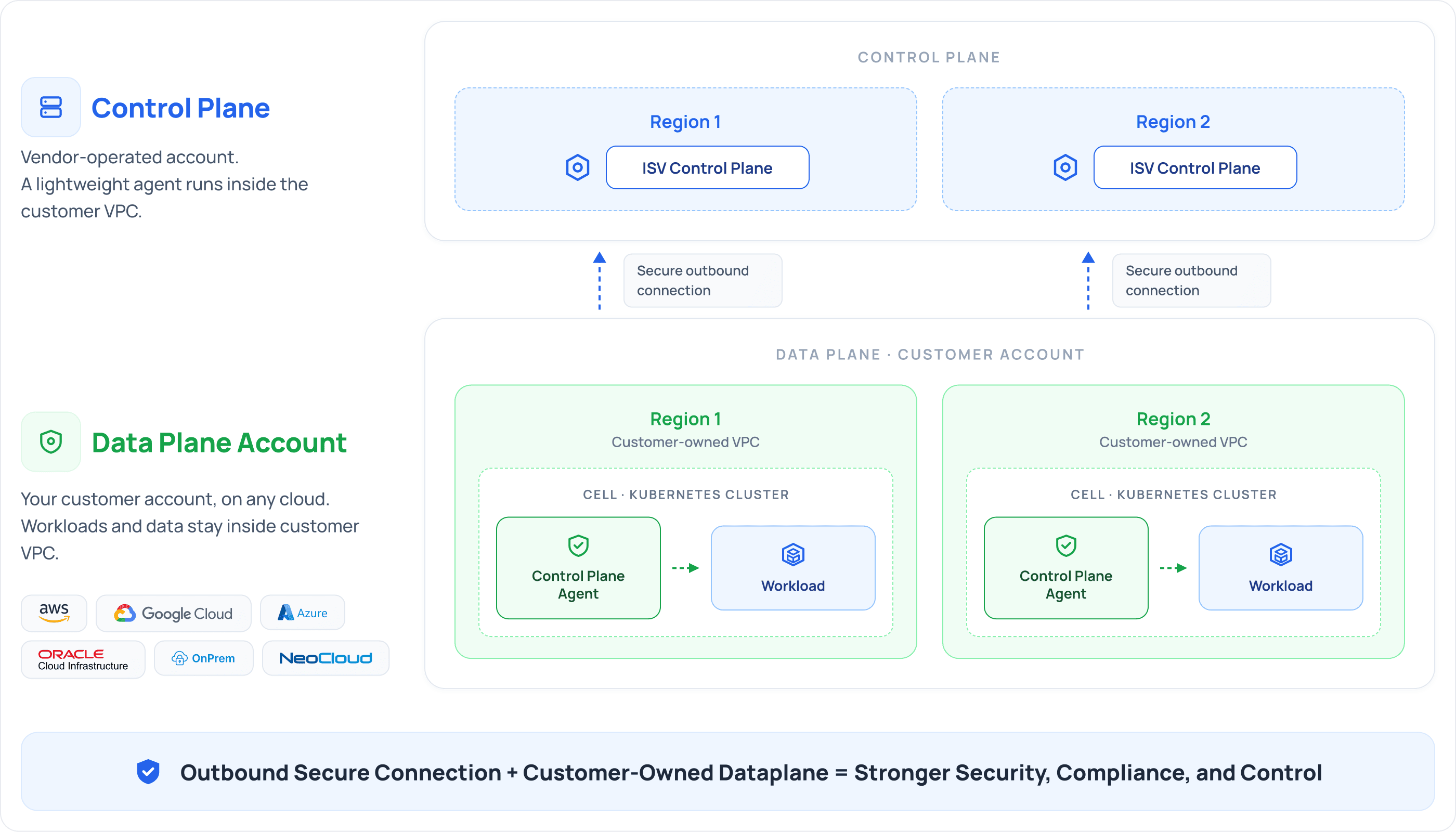
Figure 1: A two-layer BYOC architecture separating the vendor-managed control plane from the customer-owned data plane.
The key shift is this: SaaS centralizes operations in the vendor's cloud. BYOC distributes the product into the customer's environment without turning the customer into the operator. That is the important distinction. BYOC is not just "you install our software." It is managed software delivered into a customer-controlled environment.
How BYOC Differs From Air-Gapped Deployment
Air-gapped deployment is the other extreme. In an air-gapped model, the software runs in an isolated environment with no live connection back to the vendor. This is common in defense, government, critical infrastructure, and highly restricted enterprise environments.
Air-gapped deployments provide maximum isolation, but they also create operational friction:
- upgrades are slower,
- support is harder,
- telemetry is limited,
- troubleshooting requires more manual effort,
- security patches may lag,
- and each deployment can become its own operational island.
BYOC is different. It gives customers more control than SaaS, but it can still preserve a live managed-service relationship with the vendor.
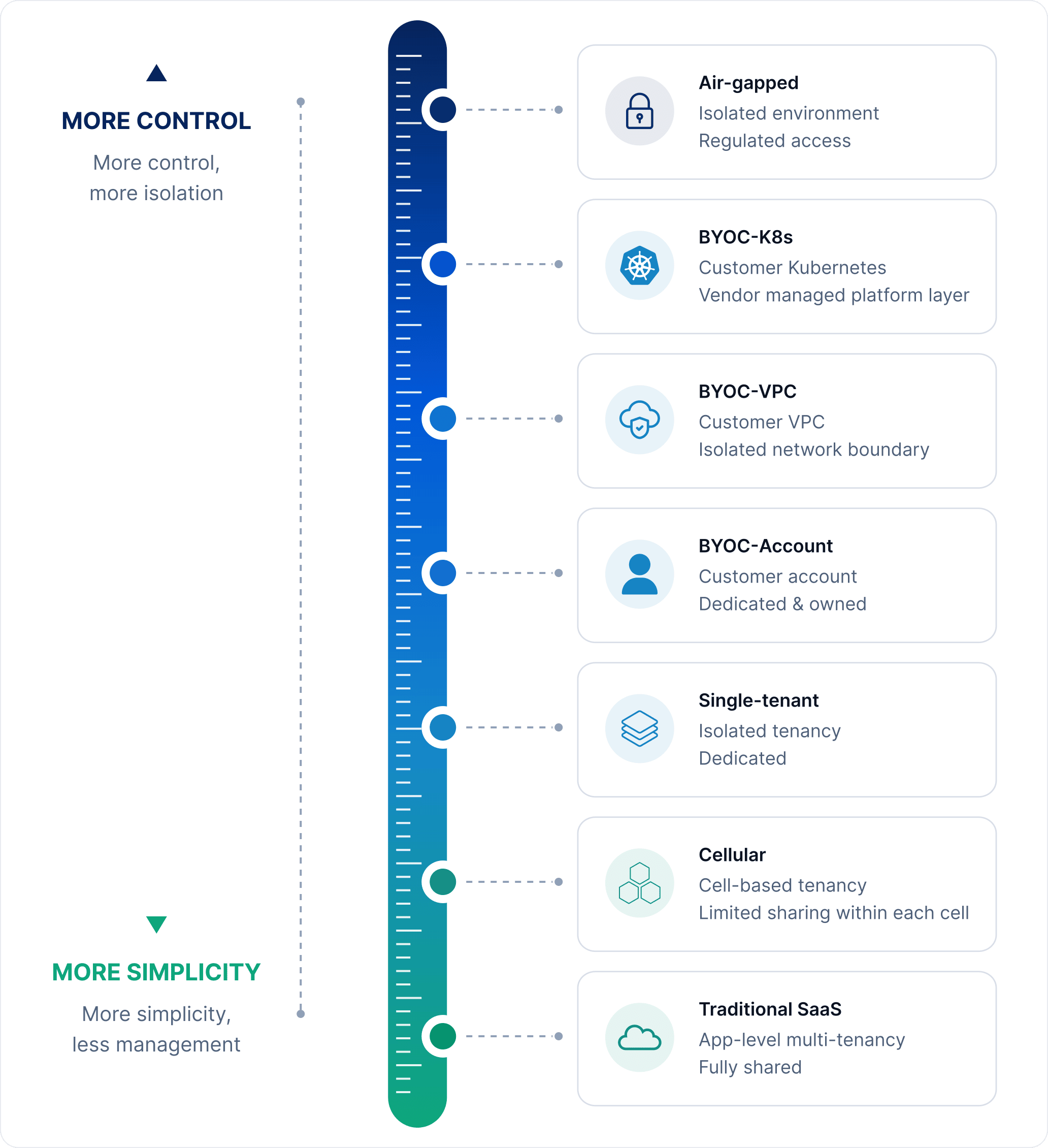
Figure 2: The spectrum of enterprise software deployment options, balancing customer control and isolation against operational simplicity.
| Model | Where it runs | Isolation | Who operates it | Vendor connectivity |
|---|---|---|---|---|
| Traditional SaaS | Vendor cloud | Shared tenancy | Vendor | Full |
| Cellular multi-tenancy | Vendor cloud | Cell-level tenancy | Vendor | Full |
| Single tenant | Vendor cloud | Single tenant | Vendor | Full |
| BYOC variants | Customer cloud account / VPC / K8s | Single tenant | Vendor-managed, customer-controlled | Controlled |
| Air-gapped | Isolated customer environment | Single tenant | Customer or vendor-assisted | None or highly restricted |
BYOC is best when the customer needs control, but not complete disconnection. Air-gapped is best when disconnection itself is a requirement.
Why BYOC Is Gaining Popularity Now
BYOC is not new. What changed is the market context. Several forces are converging at the same time: AI adoption, data sensitivity, cloud economics, regulatory pressure, and infrastructure fragmentation.
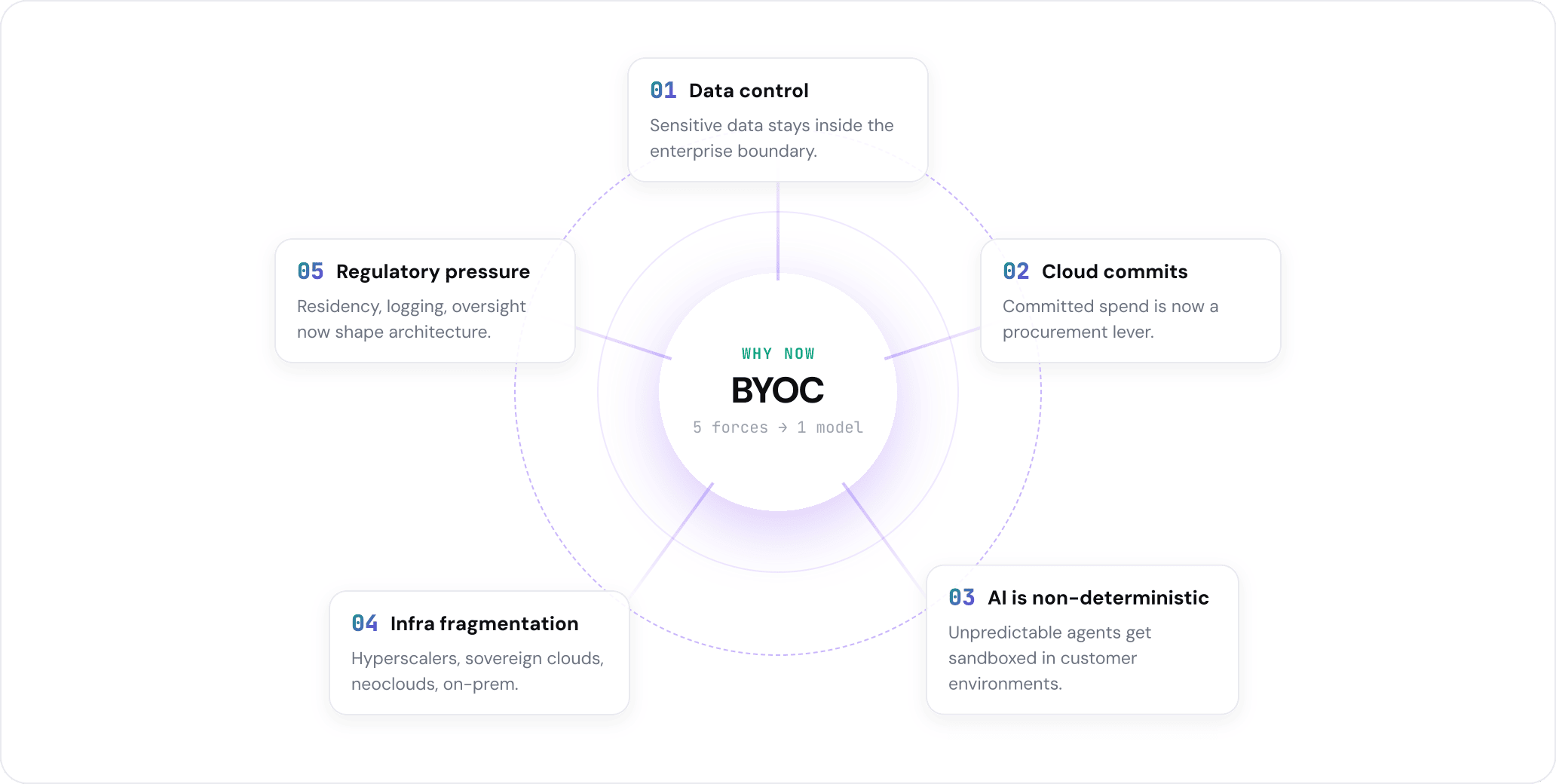
Figure 3: Five market forces driving the industry shift toward Bring Your Own Cloud (BYOC) deployments.
1. Enterprises are more cautious about sending data outside their boundary
Enterprise software is no longer just storing forms and dashboards. Modern products increasingly operate on source code, customer records, transaction histories, proprietary documents, embeddings, logs, security events, and business workflows.
AI amplifies this concern. When an AI product touches an enterprise context, the customer wants to know where prompts, retrieval data, embeddings, model outputs, logs, and agent actions are processed and stored. For many companies, "trust us, it runs in our SaaS" is no longer enough.
BYOC gives those customers a more acceptable answer: the workload can run inside their own cloud boundary, under their own account, region, network, IAM, encryption, logging, and governance controls.
2. Cloud commitments have become a procurement lever
Large enterprises already have committed spend agreements with AWS, Azure, Google Cloud, Oracle Cloud, and other providers. They often prefer software purchases and workloads that help retire those commitments.
This changes the software buying motion. A product that runs in the customer's cloud can be easier to align with existing cloud budgets, marketplace procurement, internal chargeback, and strategic cloud partnerships. AWS Marketplace, for example, emphasizes streamlined procurement, standardized contracts, flexible pricing, and thousands of software listings across categories.
BYOC makes the software vendor part of the customer's cloud strategy, not an exception outside it.
3. AI agents are less predictable than traditional applications
Traditional SaaS applications usually have predictable access patterns. A user clicks, the application responds, and the system touches a known set of data.
AI agents are different. They may retrieve context, call tools, write outputs, trigger workflows, interact with APIs, generate code, inspect logs, or operate across systems. Even with strong guardrails, their behavior is more dynamic than a typical CRUD application.
That makes enterprise buyers more cautious. They may want agentic workloads sandboxed in a dedicated environment. They may want private networking, customer-controlled credentials, isolated execution, detailed audit logs, and the ability to limit blast radius.
BYOC maps well to this pattern. It allows the software vendor to deliver the agent experience while giving the enterprise stronger control over where the agent runs and what it can access.
4. Infrastructure environments are fragmenting
The enterprise cloud landscape used to be simpler: AWS, Azure, Google Cloud, maybe on-prem.
Now customers may want workloads across hyperscalers, sovereign clouds, neoclouds, GPU clouds, customer-owned Kubernetes clusters, private data centers, and regional infrastructure providers. This is especially true for AI. GPU availability, cost, data locality, and regional requirements are pushing companies to use more than one infrastructure provider.
BYOC helps software vendors meet customers where they already operate. Instead of forcing every customer into the vendor's cloud, BYOC allows deployment into the customer's preferred environment — whether that is a hyperscaler, a neocloud, a regulated cloud, or an internal platform.
5. Regulation is becoming more operational
Regulation is no longer only about contracts and certifications. Increasingly, it affects architecture. Data residency, auditability, human oversight, logging, risk management, and operational controls matter more when software handles sensitive data or AI-driven decisions.
The EU AI Act, for example, creates obligations for deployers of high-risk AI systems, including human oversight, relevant input data, monitoring, and log retention requirements. The European Commission's AI Act service desk also ties certain deployer obligations to data protection impact assessments under GDPR.
For many enterprises, this pushes architecture discussions earlier in the sales cycle.
- They do not only ask, "Are you compliant?"
- They ask, "Can this run in a way that lets us remain compliant?"
BYOC gives vendors a stronger answer because it allows customers to apply their own controls around data location, access, logging, security monitoring, and infrastructure governance.
BYOC Is Not a Replacement for SaaS
BYOC should not be treated as a universal replacement for SaaS.
Traditional SaaS remains the best model when speed, simplicity, and centralized operations matter more than environment ownership. Air-gapped remains the right model when the customer requires full isolation or disconnected operation.
BYOC wins when the buyer needs a managed product experience but cannot fully accept the vendor-hosted SaaS model. Most customers do not want to operate every vendor product themselves. They want the vendor to manage upgrades, reliability, support, and lifecycle automation. But they also want the workload to fit inside their security model. BYOC gives both sides a workable compromise.
That makes BYOC especially relevant for:
- AI applications and agents,
- data platforms,
- security and observability products,
- developer tools that touch code or infrastructure,
- databases and stateful systems,
- regulated-industry software,
- enterprise infrastructure products,
- and software sold into large customers with strict cloud, network, or data requirements.
The Future: More Software Will Need Multiple Deployment Models
The future is not "SaaS versus BYOC versus air-gapped." The future is deployment choice.
Enterprise software companies will increasingly need to support multiple models:
- multi-tenant SaaS for trials and smaller customers,
- single-tenant SaaS for stronger isolation,
- BYOC for customer-controlled cloud environments,
- and air-gapped deployments for the most restricted use cases.
This is a major shift. Historically, many software companies treated non-SaaS deployments as exceptions: custom projects, professional services work, or one-off enterprise deals. That will not scale.
As BYOC demand grows, vendors will need repeatable deployment automation, lifecycle management, upgrades, observability, metering, support workflows, and policy controls across customer environments.
The winners will not be the companies that simply offer "deployment flexibility" in a slide deck. The winners will be the companies that can operationalize that flexibility —whether by spending years building an internal control plane or by utilizing Omnistrate's BYOC deployment framework—without turning every customer into a custom engineering project.
Who Should Adopt BYOC?
Software companies should seriously consider BYOC if they hear any of these questions from customers:
- Can this run in our cloud account?
- Can this stay inside our VPC?
- Can we use private connectivity?
- Can we use our committed cloud spend?
- Can we choose the region?
- Can we isolate each customer's environment?
- Can we keep data, embeddings, logs, or prompts inside our boundary?
- Can this run on our preferred GPU provider?
- Can this satisfy our regulatory or data residency requirements?
- Can our security team inspect and govern the environment?
If these questions are appearing repeatedly in enterprise sales cycles, BYOC is not a niche requirement. It is a signal that the product is moving into a more strategic category. For companies that already offer SaaS, BYOC can unlock larger and more regulated customers.
For companies that already offer air-gapped deployments, BYOC can provide a significantly better experience with better upgradeability, supportability, and operational consistency while continuing to operate in their closed VPC.
For AI companies, BYOC may become especially important because customers are still learning how to govern agents, models, tools, prompts, embeddings, and data flows.
The Future of Enterprise Software Deployment
BYOC is becoming one of the prominent deployment models because enterprise software is moving closer to sensitive data, critical infrastructure, and AI-driven workflows. Customers want the speed of SaaS, but they also want control over where software runs, how data moves, which cloud spend is used, and what security boundaries apply.
BYOC is the model that reconciles those needs. It lets vendors deliver managed software into the customer's cloud reality. For many enterprise software categories, it is becoming the deployment model that makes modern enterprise adoption possible.
See how teams are already shipping BYOC with Omnistrate: how PeriNimble offers BYOC deployments in regulated markets and how DataRobot automates on-prem and launches its self-managed service.
Want to deliver a managed product into your customers' clouds without turning every deal into a custom engineering project? See Omnistrate's BYOC deployment options.
To learn more, visit the Omnistrate documentation: https://docs.omnistrate.com/
To get started for free, visit here: https://omnistrate.cloud/
For any questions, reach out to us: https://calendly.com/omnistrate/meeting