
Omnistrate is a control plane generator and NOT your control plane.
Omnistrate helps software companies generate and operate a private control plane for their own product.
- Your product remains your product.
- Your customers remain your customers.
- Your customer experience remains under your brand.
- And your application continues to run in the infrastructure model you choose (your environment or your customers’ environment).
Omnistrate primarily provides the technology used to generate, run, and evolve the control plane behind that experience.
What is a control plane?
When you turn software into a managed service, deploying the application is only one part of the problem.
You also need a management layer that understands things like:
- Who the customer is
- What they are entitled to use
- Where their deployment should run
- How infrastructure should be provisioned
- How the software should be configured
- How upgrades should happen
- How usage should be metered
- How to manage the fleet
- How permissions, audit logs, and policies are enforced
- How customers provision, scale, upgrade, or delete deployments through APIs, CLI, or UI
That management layer is the control plane. Your application itself is the data plane (or agent plane or app plane).
For most software companies, building the product is only the beginning. Building the control plane required to turn it into a reliable Hosted SaaS, BYOC, on-premises, or air-gapped product can become an entirely separate engineering effort. That is the problem Omnistrate is designed to solve.
Think of Omnistrate as a control plane factory
A useful way to think about Omnistrate is as a factory for generating control planes.
You bring the software you already have: containers, Helm charts, Kubernetes operators, Terraform, OpenTofu, or other deployment definitions.
You declaratively define how your Control Plane should behave as a spec:
- deployment models
- infrastructure
- parameters
- tenancy and isolation
- regions and clouds
- versions and upgrades
- operational workflows
- pricing and metering
- customer-facing capabilities
Omnistrate turns that definition into private control plane (aka management layer) needed to distribute and operate the product from tenant onboarding, customer deployments, upgrade workflows, billing infrastructure, customer portals/APIs, fleet management, RBAC, audit logging, and multi-cloud orchestration, Omnistrate generates those capabilities as part of your control plane.
And as your customer base grows, the control plane evolves with it to support wherever your customers are and how they want to consume your agent(s) or application stack.
The most important point: your customers are still your customers
We serve you. Your customers interact with your generated control plane, through your product experience:
- Your domain: The customer-facing control plane can be exposed under your own domain.
- Your brand: The portal and customer experience can be completely white-labeled.
- Your APIs and workflows; Customers provision and manage your product through the experience you expose.
- Your communication: All communication to your generated control plane happens in your account as the generated control plane runs in your account. Customer-facing emails can use your own email domain and SMTP configuration.
- Your commercial relationship: You decide how the product is packaged, priced, sold, and supported.
From the customer's perspective, they are using your managed service—not becoming an Omnistrate customer. This distinction matters as it has important business implications:
- Close enterprise deals faster by avoiding an additional vendor relationship in the customer’s deployment and procurement process.
- Keep ownership of the account instead of sharing the customer relationship with an infrastructure or managed-service vendor.
- Build your brand, not ours. The operational platform powering the service stays behind the scenes.
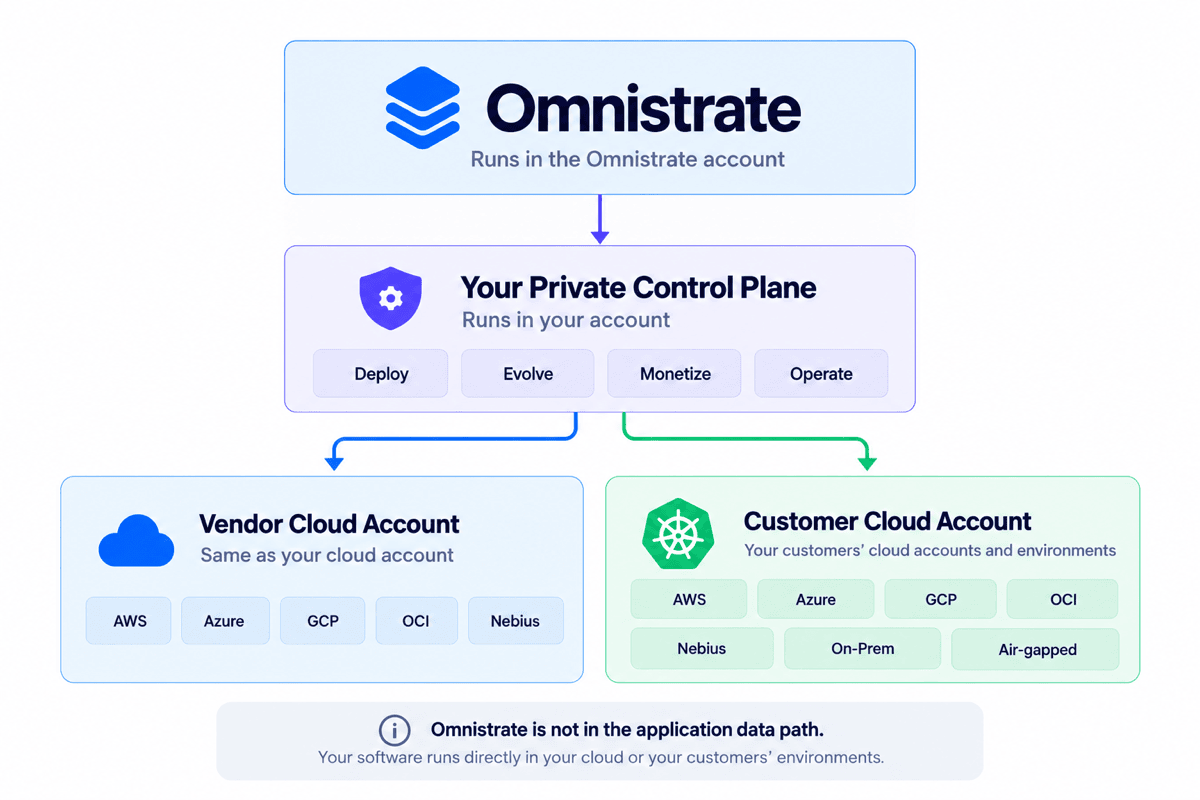
The key boundary is simple: Omnistrate powers the control plane behind the scenes. You own the product and the customer relationship.
One control plane, multiple ways to deploy
Once the control plane exists, the same product can be distributed in very different ways.
You might offer:
Hosted SaaS
The software runs in cloud infrastructure operated by you.
BYOC
The software runs inside the customer's AWS, Azure, GCP, OCI, Nebius, Kubernetes, or other supported environment while you continue to provide a managed experience.
On-premises
The software runs inside customer-controlled infrastructure.
Air-gapped
The software is delivered into disconnected environments through a signed installer and operates without a live control-plane connection.
The point is that these deployment models can be managed through the same product definition and control-plane model, rather than requiring a separate platform to be built for every distribution channel.
A concrete example: ACME wants to offer PostgreSQL-as-a-Service
Let’s make this real.
Imagine you are ACME, a software company that wants to offer PostgreSQL-as-a-Service.
You already know how to run PostgreSQL. You may have Helm charts, Kubernetes manifests, Terraform, an operator, or other automation for deploying it.
But that alone does not give you a managed service.
To offer PostgreSQL to customers, ACME also needs a control plane that can:
- onboard customers and tenants
- let customers create PostgreSQL instances
- choose versions, compute, storage, regions, and deployment options
- provision the underlying infrastructure
- configure networking and security
- perform upgrades and Day-2 operations
- manage backups, restores, and high availability
- meter usage and enforce entitlements
- expose APIs, CLI, and a customer portal
- operate the entire fleet across customers and environments
Without a control plane, ACME has to build and maintain all of this itself.
Start by defining the service
With Omnistrate, ACME starts by describing what its PostgreSQL service should look like and how it should behave.
That specification can define things such as the PostgreSQL version, infrastructure requirements, CPU and memory options, storage, parameters, networking, tenancy model, supported clouds and regions, upgrade behavior, operational workflows, pricing, and metering.
Example service specification:
View the PostgreSQL service specification: https://github.com/omnistrate-community/supabase-demo-saas
The important point is that ACME is describing the desired service, rather than implementing an entire control-plane platform around it.
Omnistrate generates ACME’s private control plane
From that specification, Omnistrate generates the management layer ACME needs to offer PostgreSQL as a managed service.
ACME now has its own control plane for capabilities such as:
- Deploy — Customers can provision PostgreSQL through ACME’s API, CLI, or customer portal.
- Evolve — ACME can introduce new PostgreSQL versions, instance types, regions, infrastructure configurations, and deployment models without rebuilding its platform.
- Monetize — ACME can define plans, entitlements, metering, pricing, and billing behavior around the service.
- Operate — ACME can manage upgrades, backups, restores, scaling, health, and fleet-wide Day-2 operations.
And importantly, this is ACME’s control plane. It can run under ACME’s account, domain, branding, APIs, and customer experience—the same ownership model described above.
What does the customer experience look like?
Now imagine one of ACME’s customers wants a new PostgreSQL deployment.
- They go to ACME’s customer portal, not Omnistrate.
- They might choose: PostgreSQL 18 → 8 vCPU → 64 GB memory → 1 TB storage → AWS → us-east-1
- and click Create.
The request goes to ACME’s private control plane, which coordinates provisioning and deployment.
Depending on how ACME wants to offer the service, that PostgreSQL instance could run:
- in ACME’s cloud account as Hosted SaaS, or
- directly inside the customer’s cloud account as BYOC.
The customer continues dealing with ACME throughout the entire lifecycle. Omnistrate provides the technology underneath that generates and operates the control-plane infrastructure.
See how the generated customer portal lets customers provision and manage their own deployments while the software vendor retains the customer-facing experience: Customer Portal for Supabase Single-tenant SaaS and BYOC built using Omnistrate
The same control plane continues for internal operations
Generating a control plane is not just about turning a Create button into a deployment.
Once hundreds or thousands of PostgreSQL instances exist, ACME still needs to operate them.
For example, ACME may need to:
- roll PostgreSQL upgrades across the fleet
- upgrade underlying infrastructure
- resize instances
- increase storage
- rotate credentials
- apply security fixes
- restore backups
- detect and remediate failures
- introduce new plans
- add a new cloud or region
- support a customer asking for BYOC instead of Hosted SaaS
Those are also control-plane responsibilities.
This is why we describe Omnistrate as a control plane generator, rather than simply deployment automation. The control plane exists throughout the entire lifecycle of the service.
See how the control plane continues beyond provisioning into Day-2 operations and autonomous management of the service: Autonomously Operate your Supabase PaaS and BYOC built using Omnistrate
That same model applies whether the underlying software is a database, AI inference engine, observability platform, security product, developer tool, or another enterprise application.
Why generate a control plane instead of building one?
Because control planes become large software products of their own.
- At first, a team may only need a deployment script.
- Then customers ask for self-service provisioning.
- Then multiple regions.
- Then upgrades.
- Then BYOC.
- Then dedicated networks.
- Then security controls like RBAC, audit logs, API Keys, SSO, encryption in transit/rest, secrets management, license managements, governance controls and so on
- Then metering, pricing, billing, cost insights.
- Then marketplace integration.
- Then fleet operations.
- Then several clouds.
- Then on-prem.
- Then air-gapped environments.
- And it goes on and on
Eventually, the control plane surrounding the original application can become as complicated as the application itself. And almost none of this work is where a software vendor differentiates.
Omnistrate’s goal is to turn this entire operational layer into a generated control plane, so you can focus your engineering resources on the product your customers are actually buying.
- Faster time to market: We can generate the first version of your control plane in a fraction of the time it would take to build one from scratch, dramatically accelerating your time to market.
- Unblock deals: When a new customer asks for a different cloud, region, deployment model, security boundary, networking configuration, or even an air-gapped environment, you shouldn’t have to launch another infrastructure project. The control plane can evolve to support those requirements without rebuilding your platform for every customer.
- Lower cost to operate: And it is significantly more cost-effective than operating this layer yourself. This is the problem we hyper-focus on. We work with hundreds of software vendors and have years of experience running production control planes at scale, allowing every customer to benefit from infrastructure, operational patterns, and capabilities that would be expensive for any individual vendor to build and maintain independently.
- World-class control plane: We continue investing in the platform—adding new deployment models, clouds, operational capabilities, security controls, and automation—so your control plane keeps getting better without requiring you to build all of that innovation yourself.
What Omnistrate is—and what it isn't
The simplest way to describe the model is:
You build the product. Omnistrate generates the control plane. Your customers consume the product from you.
- We are not a reseller sitting between you and your customer.
- We are not trying to replace your brand with ours.
- We are not asking your customers to become Omnistrate customers.
- And we are not trying to move customer application traffic through an Omnistrate data plane.
We are the infrastructure behind the infrastructure: the platform that helps you generate, operate, and evolve the management layer for your software.
That is what we mean by control plane generator. And ultimately, that is the model we want software companies to have:
Your product. Your customers. Your control plane. Powered by Omnistrate.