
For the last decade, enterprise software followed a simple default: build a multi-tenant SaaS application, run it in the vendor’s cloud account, and expose it through an API or web interface. That model worked because the vendor could centralize everything: the application, customer data, infrastructure, operations, upgrades, observability, and billing.
Enterprise AI is breaking that assumption. AI changes not only what software does, but also how quickly it is built, where it must run, and how it must be operated. This creates what we call the 3D Shift:
- Development is accelerating.
- Deployment is fragmenting.
- Day-2 operations are multiplying.
AI compresses development, fragments deployment, and multiplies Day-2 operations.
Together, these shifts create a new infrastructure category: the distribution layer of AI infrastructure—the layer that allows AI products to be built once, delivered wherever the customer and workload require, and operated consistently across every environment.
That requires a control plane built for the AI era.
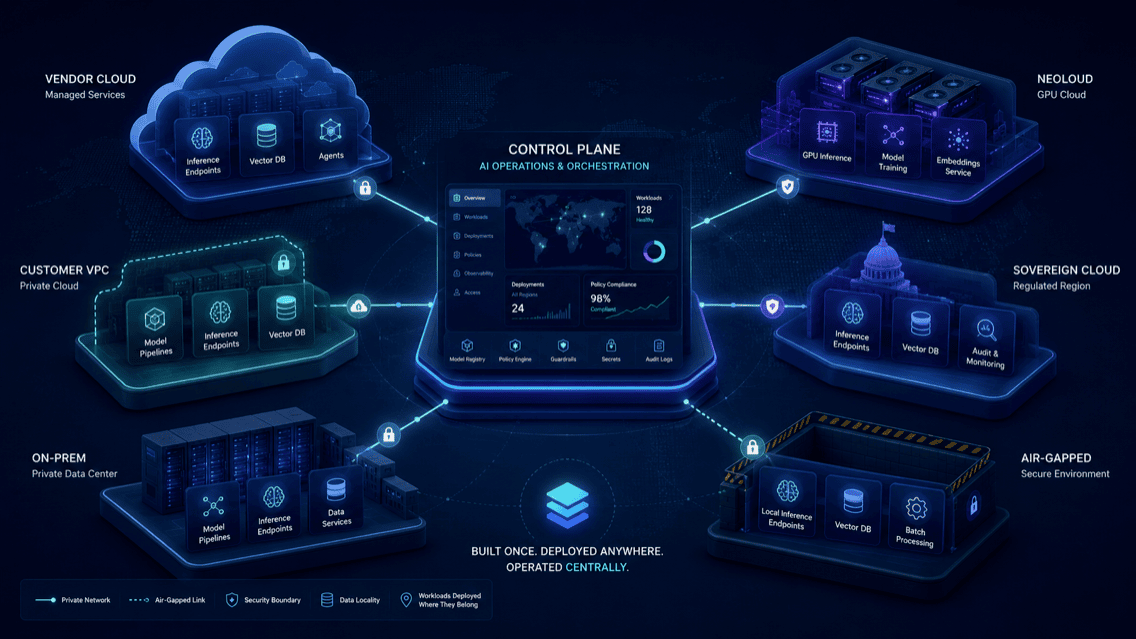
Figure 1: The distribution layer — one control plane operating the same product across vendor cloud, neocloud, customer VPC, sovereign, on-premises, and air-gapped environments.
Development: The Bottleneck Is Moving Downstream
AI coding agents are dramatically reducing the time required to create application logic, integrations, workflows, APIs, infrastructure automation, and routine CRUD functionality. The need for this software has not disappeared. The time and effort required to produce it are collapsing.
As a result, teams can build more products, release more features, and create more customer-specific functionality than before. But generating working software is not the same as delivering an enterprise-ready product.
The harder work increasingly begins after the code has been written:
- Packaging and releasing the software reliably.
- Deploying and connecting the application components.
- Upgrading and supporting it throughout its lifecycle.
- Repeating the process reliably for every release.
- Creating a secure environment for new customers.
- Provisioning the infrastructure it requires.
- Integrating with each customer’s network, identity, and security boundaries.
As AI automates development, the rest of the software lifecycle must keep pace. The path from code to production must now be automated with it.
That challenge is compounded by another shift: there is no longer a single standard environment in which the product runs.
Deployment: The Runtime Landscape Is Fragmenting
Traditional SaaS assumes that the vendor chooses where the product runs. For AI systems, the application often operates on the most sensitive corporate context: documents, prompts, retrieved data, embeddings, user metadata, tool outputs, source code, operational records, and agent memory. An agent may also call internal APIs, access business systems, maintain state, and take actions on the customer’s behalf.
The question is therefore no longer only: Is your SaaS secure?
It is increasingly: Can your product run inside our environment?
More broadly, enterprise AI makes workload placement dependent on a diverse set of constraints: where the data lives, where GPUs are available, which security boundary the customer requires, what infrastructure the customer already owns, which regulatory requirements apply, and where the economics make sense.
In other words, the same AI product may need to run in very different environments.
- A customer may prefer a hyperscaler because it already relies on its managed services, security controls, marketplace, cloud credits, and enterprise agreements.
- Another may prefer a neocloud or specialized GPU provider because it offers better accelerator availability, performance, or cost.
- A large enterprise may require the product to run in its own cloud account or private VPC so that data, access controls, and network traffic remain inside its established boundary.
- A regulated customer may require a sovereign region, an on-premises deployment, or an air-gapped environment with no dependency on an external runtime connection.
The infrastructure challenge is not simply choosing the best cloud. It is supporting all the environments the market requires without maintaining a different product, deployment architecture, upgrade process, and operating team for each one.
A serious enterprise AI strategy cannot be constrained to one runtime destination. But being available everywhere cannot mean rebuilding the product for every environment.
That is the distribution problem.
Day-2: Distributed Software Must Still Feel Managed
Moving the workload into different environments solves only part of the problem. Customers still expect a managed-service experience. They expect the product to remain available, secure, observable, upgradeable, supported, and governed after it has been deployed. The vendor therefore faces a difficult operating model: the application plane becomes distributed, but operational responsibility remains centralized.
This is especially challenging for AI workloads:
- This is especially challenging for AI workloads because they are rarely deployed as a single stateless service. A production AI product may include inference services, vector databases, data pipelines, agent runtimes, APIs, observability components, and supporting infrastructure, each with its own compute, storage, networking, and scaling requirements.
- GPU infrastructure also introduces isolation and sharing choices—such as dedicated devices, time-slicing, NVIDIA MIG—each with different performance, security, and cost tradeoffs. Those choices vary further across NVIDIA GPUs, AMD accelerators, TPUs, and other specialized hardware.
- AI infrastructure must account for GPU type and availability, CUDA setup, scaling behavior, shared storage, model loading, and workload-specific latency.
These are not only application concerns. They are infrastructure and operating-model concerns. The difficulty multiplies when every customer deployment runs in a different account, network, cluster, cloud, region, or data center.
Without a shared operating layer, every enterprise deployment becomes a custom professional services project. Provisioning happens through tickets. Upgrades require manual coordination. Metering and billing becomes manual and error-prone. Failures are diagnosed differently in each environment. Security exceptions accumulate. Operational cost grows with every new customer.
The product may be distributed, but the operations cannot be multiplied.
From Centralized SaaS to Distributed AI Operations
Taken together, the above 3D shift points to a deeper change in how AI infrastructure and agentic applications must be delivered.
Traditional SaaS was built around centralization. The vendor hosted the application and data plane, while also controlling operations, upgrades, billing, and the customer experience. Enterprise AI is separating these concerns: the application, data, and operations can no longer be assumed to live in the same place.
Vendors still need centralized management—fleet-wide visibility, consistent releases, shared policies, and a repeatable managed-service experience—but customers want the convenience of a managed service and the control of private infrastructure.
Hence, the application and data planes increasingly need to run wherever the customer’s data, infrastructure, and security boundaries reside: in customer accounts, private VPCs, specialized GPU clouds, sovereign regions, on-premises clusters, or disconnected environments.
This creates the defining architectural requirement of enterprise AI: centralize how the product is managed without centralizing where it runs. It gives customers the deployment model, data locality, infrastructure choice, and security posture they require, while preserving the vendor’s ability to operate the product continuously as a managed service.
It is not a return to traditional on-premises software, where the vendor ships an artifact and loses operational control. It is also not an attempt to force every enterprise AI workload into centralized, multi-tenant SaaS.
The vendor continues to own:
- The product definition.
- The release process.
- The operational workflows.
- The customer experience.
The control plane manages:
- Deployment and infrastructure orchestration.
- Lifecycle operations and upgrades.
- Observability and incident response.
- Identity, policy, and governance.
- Metering, billing, and fleet management.
These requirements in-turn change what it means for an AI product to be enterprise-ready. A compelling product, an impressive demo, and a compliance report are no longer enough. Customers increasingly ask:
- Can the product run in our cloud account?
- Can it remain inside our VPC?
- Can it use our GPU capacity?
- Can it operate without public ingress?
- Can it deploy in our preferred region?
- Can we procure it through our cloud marketplace?
- Can you prove where our data resides?
- Can you upgrade and support it after it is deployed?
When each answer requires a custom engineering project, every enterprise deployment becomes a services engagement. When these capabilities are built into the distribution layer, the vendor can support more customers and infrastructure choices through one consistent operating model.
What The Distribution Layer Must Provide
A distribution layer is not simply a deployment script. It is not Kubernetes, Terraform, a CI/CD pipeline, or an administrative dashboard by itself. It is a full-lifecycle control plane responsible for three jobs.
1. Deploy the product consistently
The product team should define its application architecture once and expose the appropriate delivery model for each customer.
The control plane must translate that product definition across deployment models—from hosted and single-tenant SaaS, BYOC to air-gapped—and across infrastructure environments, including customer VPCs, neoclouds, sovereign clouds, on-premises clusters, and disconnected environments.
It must understand the differences between those environments rather than pretending they are identical. That includes infrastructure APIs, networking models, identity boundaries, accelerator types, node pools, storage systems, runtime dependencies, capacity constraints, and isolation requirements.
The objective is architectural consistency, not environmental uniformity. The same product should behave predictably everywhere, while still respecting the controls and capabilities of each destination.
2. Operate every deployment as one fleet
Deployment is an event. Operations are continuous. The control plane must automate provisioning, configuration, scaling, upgrades, canaries, rollbacks, backups, restoration, repair, and decommissioning across the entire fleet.
It must also provide a unified operational view when the underlying application environments are distributed across customer-controlled infrastructure.
For AI workloads, this includes traditional system metrics such as CPU, memory, disk, network, availability, and latency, as well as AI-specific signals such as GPU utilization, queue depth, token throughput, model version, model-loading time, retrieval performance, embedding latency, tool-call failures, and cost per customer or workload.
The vendor needs one place to understand the state of the product, even when it does not own every environment in which the product runs.
3. Govern and commercialize the service
Enterprise delivery requires more than keeping the service available. The control plane must operate within the customer’s trust boundary: using short-lived workload identity instead of static credentials, enforcing customer-defined permissions, respecting customer-controlled networking and data paths, and delivering software through supply-chain controls the customer can inspect and gate. Every deployment and operational action must be attributable and visible in both vendor and customer audit systems, while access remains revocable by the customer at any time.
For agentic systems, these controls must extend to the agents themselves—including which agents are deployed, what data and tools they can access, which policies govern their actions, and how those actions are recorded and audited.
The same operating layer must connect technical consumption to commercial operations. AI products may be priced by API request, token, GPU-hour, storage, embedding, seat, agent, deployment, or a workload-specific unit. Customers may procure through private offers, cloud marketplaces, committed cloud spend, or conventional contracts.
The distribution layer should connect runtime usage to metering, billing, entitlements, and marketplace fulfillment. Otherwise, engineering, operations, finance, and sales teams are left reconciling different versions of what the customer deployed and consumed.
Conclusion: AI Needs A Distribution Control Plane
The AI infrastructure conversation has largely focused on models, GPUs, frameworks, and developer tools—the building blocks required to create AI products. All are necessary, but none solves the last-mile problem: getting a working product into the environments enterprises require and operating it there as a managed service.
That last mile is becoming harder. AI is accelerating software creation while simultaneously fragmenting the deployment landscape. This mismatch is becoming a breaking point for enterprise AI. Software is not valuable merely because it can be generated; it must be securely delivered, reliably operated, continuously upgraded, properly governed, and commercially supported wherever the customer needs it to run.
The naive approach is to bridge this gap with scripts, tickets, CI/CD pipelines, and one-off customer deployments. It may work for the first few customers, but it does not scale. Every new environment introduces another infrastructure integration, networking model, security review, upgrade path, and operational process. Engineering teams become deployment teams. Product velocity slows. Margins erode. Enterprise deals remain blocked by work that has little to do with the product’s core differentiation.
The current mechanisms to manage through scripts, tickets, CI/CD pipelines, and one-off deployments are not sufficient. AI needs a control plane for distributing products, not merely provisioning infrastructure.
Every new environment introduces another infrastructure integration, networking model, security review, upgrade path, and operational process. Engineering teams become deployment teams. Product velocity slows. Margins erode. And enterprise deals remain blocked by work that has little to do with the product’s core differentiation.
- AI therefore needs a control plane for distribution—not merely one for provisioning infrastructure.
- A control plane that can deploy the same product across every relevant environment.
- A control plane that preserves the managed-service experience even when the application runs inside customer-controlled infrastructure. The BYOC Anywhere framework provides a deeper view into what this requires.
- A control plane that turns a collection of isolated customer deployments into one governable, observable, upgradeable, and commercially operable fleet.
At Omnistrate, we believe the distribution layer will become one of the foundational infrastructure primitives of the AI era. Our focus is helping software and AI infrastructure companies build once, distribute anywhere, and operate every deployment as a managed service—across hosted, BYOC, private, on-premises, and customer-controlled environments.
Because in enterprise AI, a product is not truly ready when the code works. It is ready when it can be delivered and operated wherever the customer needs it to run.